
Approach Anxiety in Men: Why You Freeze and How to Stop It
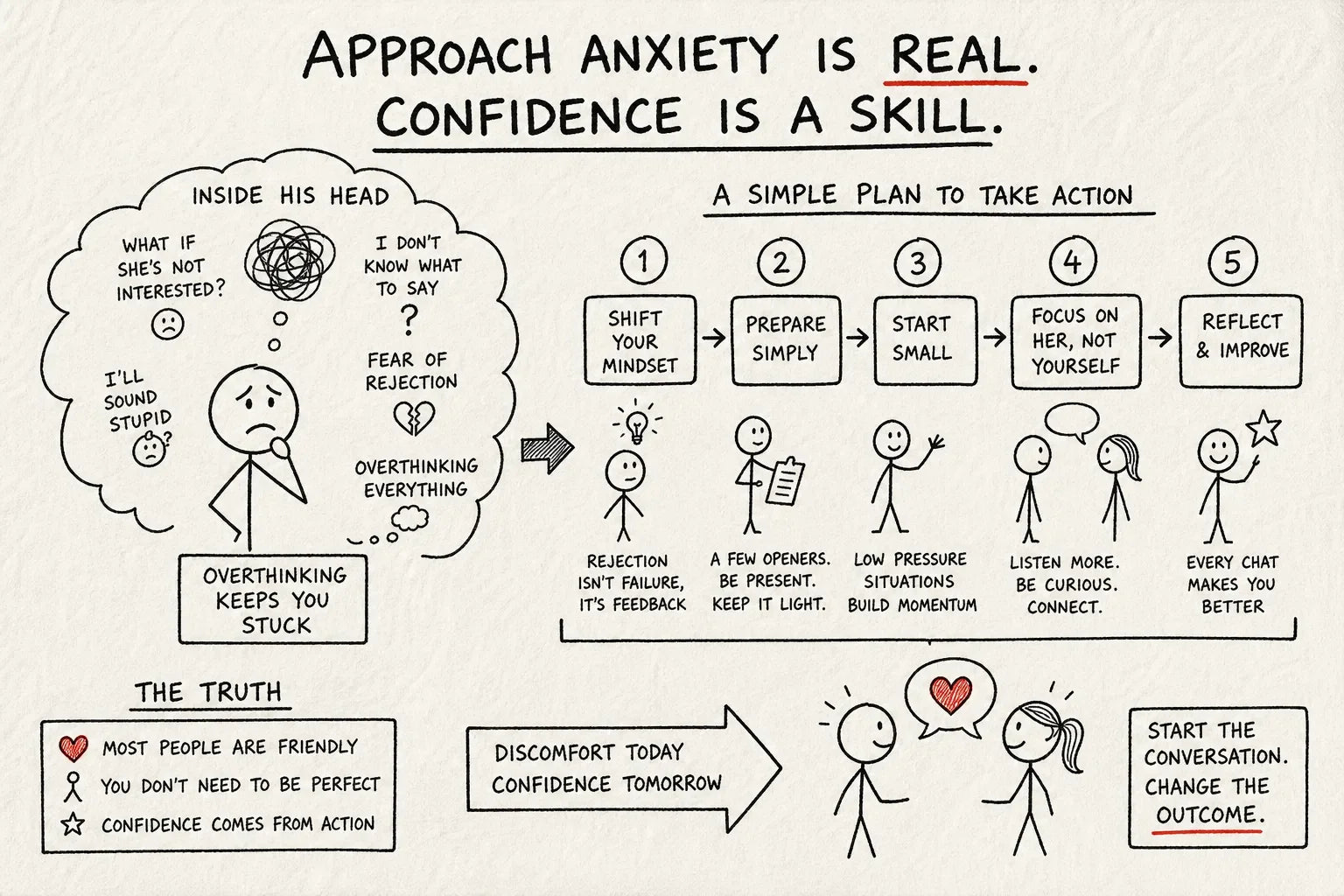
Approach anxiety men experience often looks like this: you see her, you think I'll go over in a second, then your body does something strange and locks up. Your heart rate climbs, your mind runs through every possible way this could go wrong, and before you've said a single word, the moment passes. You tell yourself you'll do it next time. Next time arrives and goes the same way.
This isn't a character flaw and it isn't permanent. It's a trained fear response with identifiable causes, and those causes can be worked on. Three things typically drive it: fear of rejection, perfectionism, and the way male social norms around vulnerability and help-seeking can amplify avoidance. The psychology behind all three is the same foundation built into the practical guides at The Attraction Vault, and it's what this article unpacks.
What's actually happening when you freeze
Your brain's threat systems respond to social rejection cues in much the same way they respond to physical danger. When you spot someone you want to approach, your amygdala scans the situation and reads the risk of rejection as danger. Adrenaline floods your system before conscious thought even has a chance to weigh in. You're not being irrational; you're being primal.
This response likely evolved for good reason. Being cast out from the group, for early humans, may well have meant death, and there's a plausible evolutionary case that the amygdala came to treat social exclusion as a survival risk. That wiring is still running today. Walking up to a stranger in a pub doesn't carry the same stakes as tribal exile, but the amygdala doesn't make that distinction. It fires the same alarm regardless of the actual threat level.
The amygdala isn't broken, it's just wrong about the threat
The freeze response is the body applying a physical-danger solution to a social situation. Approach anxiety is not irrational fear; it's a sensible system misfiring in the wrong context. The goal isn't to eliminate the response: it's to teach your nervous system, through repeated experience, that the predicted danger doesn't materialise.
Fear of rejection, perfectionism, and social conditioning as fuel
Three psychological accelerants make the physiological freeze worse. Fear of rejection means you're not just nervous about one specific person, you're anticipating humiliation, and your brain is treating that anticipation as fact before anything has happened.
Perfectionism adds a second layer: you wait for the perfect opener, the perfect moment, the perfect version of yourself, and since none of those arrive, neither does the approach. Then there are the broader male social norms, the quiet pressure to be low-maintenance, to not seem try-hard, to treat putting yourself out there as slightly embarrassing. That conditioning sits underneath everything else and amplifies both of the others.
Recognising your own approach anxiety triggers before they hijack you
Understanding the mechanics is useful. Knowing your specific triggers is more useful. Many men who struggle with approach anxiety are aware that they get anxious in these moments, but few have mapped exactly what fires it off, what thoughts run through their head, or what they habitually do to escape the discomfort. The pattern is always running; you're just not watching it closely enough.
The internal script that runs before you even move
Before you've taken a single step, your mind is already writing the outcome. It sounds like: "She's probably not interested." "I'll come across as weird." "She looks busy." This anticipatory catastrophising isn't a reflection of reality; it's a mental rehearsal of rejection that your brain treats as prediction rather than possibility. The thoughts arrive so quickly they feel like observation. They're not. They're a story your nervous system tells to justify staying put.
Safety behaviours that make it worse over time
Safety behaviours are the small things you do to manage anxiety in the moment: hovering on the edge of a group, over-rehearsing your opener until the situation dissolves, glancing at your phone to look occupied. They reduce discomfort in the short term, which is why they stick. The problem is that they prevent your nervous system from ever learning that the feared outcome probably won't happen. Each time you rely on a safety behaviour, you reinforce the belief that approaching is dangerous, and the avoidance loop tightens.
Evidence-based techniques that rewire the freeze response
The most well-supported treatment for social anxiety is cognitive behavioural therapy combined with graded exposure. The research on this is consistent across multiple meta-analyses. Mindfulness has a supporting role but it's a supplement, not a solution. What all of these approaches share is a single goal: break the avoidance cycle, enter the situation, and let your nervous system update its threat assessment through experience.
Cognitive restructuring in practice
Cognitive restructuring starts with identifying the automatic thought, then testing it against evidence. Take the thought: "She'll think I'm a creep for approaching her." The restructuring question is simple: what's the actual evidence for that? Many people, when they push on this honestly, realise they're predicting outcomes they can't possibly know in advance. A more realistic appraisal sounds like: "Most people respond neutrally to a polite approach. Some will be interested. A few won't. Neither result is a verdict on me as a person."
Graded exposure and why small steps build real confidence
Graded exposure is the gold standard for approach anxiety. You build a fear ladder, a ranked list of approach situations from lowest to highest distress, rated on a 0–10 scale. You start at the bottom rung and repeat it until your anxiety drops by roughly half before moving up. The key principle is that confidence doesn't come from waiting until you feel ready. It comes from repeated, manageable contact with discomfort until the nervous system stops registering it as a threat.
Using mindfulness to stay in the moment instead of escaping
Approach anxiety thrives on self-focused attention: the internal monitoring loop that tracks how you're coming across instead of engaging with the actual person in front of you. Mindfulness trains your attention outward, which breaks that cycle. It won't replace exposure, but practised alongside it, it makes each exposure more effective by keeping you present rather than retreating into anxious observation of yourself.
A 30-day practice plan for approach anxiety men can realistically stick to
The principle is straightforward: don't start with your hardest situation. Build the habit of approaching through situations that feel manageable, then progress methodically. The fear ladder is the tool; daily tracking is the accountability mechanism that makes it work.
Building your fear ladder (and where to start)
- 2/10: Make eye contact and nod at a stranger passing on the street
- 3/10: Ask a barista a non-transactional question ("Which roast do you prefer?")
- 5/10: Make a brief, situational comment to someone near you in a social setting
- 7/10: Start a conversation with someone you find attractive in a low-pressure environment
- 9/10: Approach someone in a pub and introduce yourself directly
Start at the rung that rates 2–3 out of 10 on your personal scale. Repeat it daily until it no longer produces meaningful anxiety, then move up.
Week-by-week progression and how to track it
- Days 1–7: Build your ladder, choose your starting rung, practise it daily. Record starting, peak, and ending anxiety each time.
- Days 8–14: Move to the next rung once the previous feels clearly more manageable.
- Days 15–21: Continue progressing — daily exposure is more effective than weekly.
- Days 22–30: Work the harder rungs and track measurable change.
Natural openers that work in real Australian settings
Scripts matter less than people think, but having something to say matters more than people admit. Notice something specific in your environment, say the obvious interesting thing about it, let the other person respond. That's the whole formula.
Setting-specific openers for bars, cafés, and social events
- Pub or bar: "Is the DJ actually good, or are we all just going along with it?" / "Have you tried anything off the menu?"
- Café: "What do you usually get here?" / "That looks good, I might steal your order."
- Social event: "What brought you here tonight?" / "Have you been to one of these before?"
If the response is brief or uninterested, exit cleanly: "Good to meet you anyway, enjoy the night." That isn't failure; it's information.
When to seek professional support
Approach anxiety exists on a spectrum. If it's showing up mainly in dating situations and you're otherwise functioning fine, a structured self-help plan is a reasonable starting point. If the anxiety is limiting multiple areas of your life — avoiding social events, withdrawing from friendships, struggling at work — a registered psychologist using CBT is the appropriate next step. Start with a GP referral. Australian prevalence data suggests roughly 5% of males experience social phobia in any given year — if this is affecting multiple areas of your life, you're far from alone, and effective treatment is available.
The path forward
Approach anxiety in men is not a personality type and it's not permanent. It's a learned fear response, and fear responses change through graduated, consistent exposure to the thing you've been avoiding. Build your fear ladder today. Make eye contact with a stranger tomorrow morning. The first step doesn't need to be large — it just needs to happen.
🎯 THE APPROACH BLUEPRINT
You knew exactly what you wanted to say. You said nothing.
The Approach Blueprint is a 16-page practical guide built for exactly this problem. Six steps, in order, using the OCI framework — Observe, Connect, Invite. Written for Australian settings. No pickup tactics, no scripts, no techno-babble.
- 🎯 The 6-step OCI framework
- 🎯 10 things to notice when your mind goes blank
- 🎯 10 signs you're about to talk yourself out of it
- 🇦🇺 Written for Australian pubs, footy clubs and markets
- ⚠️ 30-day unconditional money-back guarantee
-
Posted in
approach anxiety, australia, beginners, confidence, dating advice for men, social anxiety