
How to Talk to Women Confidently: A Real Man's Guide
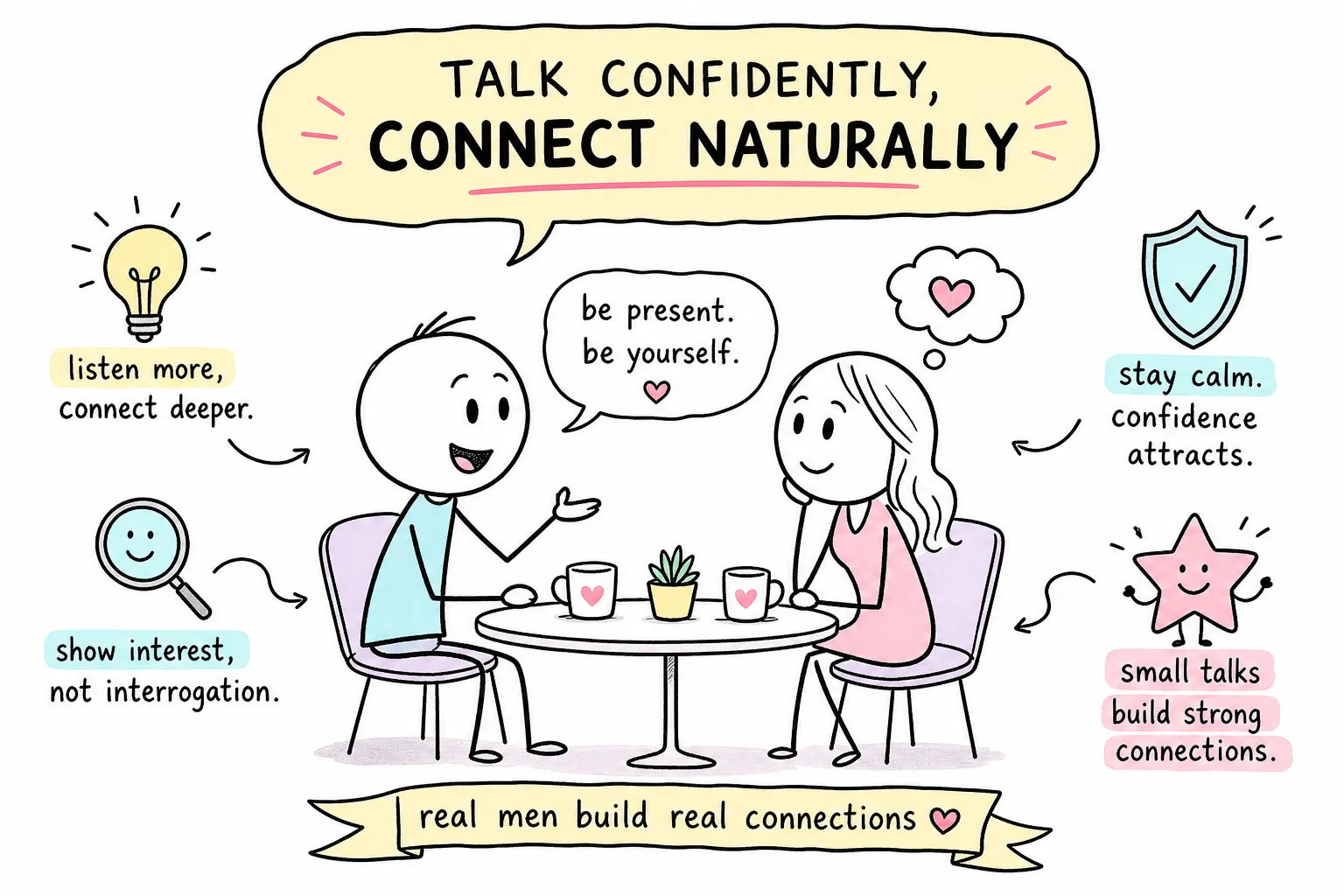
Many men who struggle to talk to women confidently don't have a script problem, they have a mindset problem.
The freeze is real. You see a woman you'd like to speak to, your chest tightens, your mind goes blank, and the moment passes before you've done anything. That's not a personality flaw. Studies on social anxiety and dating contexts suggest that anywhere from a third to well over half of men experience meaningful anxiety in these situations, so you're in very common company.
The difference between men who approach calmly and men who freeze isn't that one group has better lines. It's that one group has stopped treating the conversation as a performance with a pass or fail outcome. This guide covers body language, natural openers, signal-reading, and daily drills that build the kind of conversational confidence that actually sticks.
The mindset shift that actually changes everything
Stop treating it like a performance
Most men walk into a conversation trying to impress, to land a date, or to avoid embarrassing themselves. That pressure is precisely what makes them freeze or sound rehearsed. The interaction becomes a test, and tests trigger performance anxiety.
The shift is straightforward: treat the conversation as two people getting to know each other, not an audition. Clark and Beck's cognitive model of social anxiety supports this. When men challenged their predicted outcome against what actually happened, the feared result rarely materialised. The anticipation was almost always worse than the reality.
Curiosity is the actual secret
When your attention moves from "how am I coming across?" to "what's interesting about this person?", anxiety drops noticeably. Work by Clark and Wells on self-focused versus other-focused attention shows that self-monitoring fuels anxiety during social interactions. Shifting your attention outward interrupts that cycle.
The practical frame is simple: go into the conversation wanting to find out one interesting thing about her. That's a manageable goal, and it orients your mind toward her rather than toward your own performance. In the first 30 to 60 seconds, that's all you need.
How to talk to women confidently through body language
Posture, eye contact, and physical presence
Rolled shoulders and a dropped chin communicate nervousness before you open your mouth. Upright posture, relaxed shoulders, and steady but natural eye contact read as calm and assured. Studies on first-impression formation consistently find that people who maintain moderate eye contact are judged as more intelligent, competent, and sincere, often before a word is exchanged.
A slow, deliberate approach signals self-assurance. Rushing signals anxiety. People read body language first and words second, so the way you carry yourself in those first few seconds before you speak sets the tone for everything that follows.
Positioning yourself naturally without crowding
Approach from the front or a slight side angle. Coming from directly behind startles people and reads as aggressive, regardless of intent. Maintain a comfortable conversational distance, roughly an arm's length, and let her adjust it if she wants to close the gap.
These details communicate social awareness and respect. They're not tricks; they're the basic non-verbal vocabulary of a confident man who understands how social space works.
How to open a conversation without sounding scripted
Conversation starters that feel genuine
The best conversation starters are rooted in where you are and what's happening around you. "Have you been here before?" or "What do you usually order here?" are low-stakes, easy to answer, and feel completely spontaneous because they are. A sincere, specific compliment followed by a question — "I like your jacket. Where did you find it?" — also works well because it's personal without being invasive.
Avoid generic openers like "So what do you do?" straight out of the gate. It feels like a job interview, not a conversation, and it signals that you're running through a checklist rather than actually responding to her as a person.
Where to take it after the first line
Ask one follow-up question based on what she actually says. This signals that you're listening rather than waiting for your next move. Brief observations about the shared environment can extend the moment without forcing it.
The goal of the first 60 seconds is simply to establish comfort. You don't need to be witty, impressive, or memorable — you just need to be present and genuinely interested.
Reading her signals so you know where you stand
Signs she's engaged and comfortable
Receptive cues appear in clusters, not in isolation. Watch for her body angling toward you, relaxed posture, natural eye contact, easy back-and-forth flow, and a genuine smile rather than a tight, polite one. Leaning in slightly is a strong indicator that she's present in the interaction, not just being polite.
When these cues appear together, the conversation is working. That's your green light to keep it going naturally, not to rush toward asking for her number.
Signs to step back and how to exit with class
Discomfort also shows in clusters: torso turning away, crossed arms, reduced eye contact, short clipped answers, or scanning the room. One awkward moment doesn't mean she's uncomfortable. A sustained pattern of closed signals does.
A clean exit sounds like this: "It was good talking to you. Enjoy your evening." No pressure, no lingering. Pushing past clear discomfort signals is what turns a normal conversation into a genuinely bad one, and it's entirely avoidable.
Mistakes that shut the conversation down early
The self-focused habits that kill rapport
Talking too much about yourself, correcting her opinions, or steering the conversation toward your agenda kills rapport quickly. Self-deprecating openers are equally damaging — starting with "I'm not usually good at this..." undermines your own presence before you've given her a reason to engage.
What to say instead
Acknowledge something she says before responding with your own take. "That's interesting, how did that come about?" is simple, keeps the conversation mutual, and costs you nothing. People disengage when they feel unheard. They stay engaged when the interaction feels genuinely mutual.
Daily drills that build real conversational confidence
Breathing and micro-rehearsal before you go out
One to two minutes of diaphragmatic breathing before a social situation — with a longer exhale than inhale — measurably lowers physiological arousal. Micro-rehearsal is equally practical: practise one opener, one follow-up question, and one natural exit line out loud before you leave the house. These aren't performance tricks; they're tools that give your nervous system a reference point so the real situation feels familiar rather than alarming.
Building the habit through graded exposure
Start small. Say hello to a shop assistant, ask a stranger for a recommendation at a café, hold brief small talk while waiting for your order. Clinical research on graded exposure finds that consistent, repeated low-stakes interactions produce noticeable reductions in anxiety over several weeks. Repetition reduces anxiety more reliably than isolated bursts of motivation.
Start today, not when you feel ready
The ability to talk to women confidently is not a personality trait you're born with. It's a skill built through understanding and repetition. Presence, curiosity, and consistent practice matter far more than clever lines or rehearsed openers.
The discomfort you feel in the early stages is expected and normal. It doesn't mean you're doing it wrong; it means you're doing it. Every awkward moment is a data point, not a verdict on your character. Pick one opener from this article, use it once today, and then honestly compare what actually happened with what you feared would happen. That gap is where confidence grows.
Frequently asked questions
Why do I freeze when I try to talk to women?
Freezing is usually a mindset problem, not a personality flaw — it's performance anxiety caused by treating the interaction like a test. Research from Clark and Beck shows many men experience social anxiety in dating contexts, and the feared outcomes almost never materialise when tested against reality.
How can I stop treating conversations with women like an audition?
Shift your frame from impressing or avoiding embarrassment to two people getting to know each other. Go into the conversation wanting to find out one interesting thing about her — that single goal reduces pressure and redirects your attention outward where it's useful.
What should I focus on during the first 30 to 60 seconds?
Aim to discover one interesting thing about her rather than monitoring how you come across. That outward curiosity lowers self-focused anxiety and makes natural conversation more likely.
What body language makes me appear more confident?
Upright posture, relaxed shoulders, and steady but moderate eye contact signal calm and assurance. A slow, deliberate approach reads as self-assured while rushing reads as anxious. People read nonverbal cues first — carry yourself calmly and it sets the tone before you speak.
How close should I stand and from which angle should I approach?
Position yourself at a comfortable conversational distance — roughly an arm's length — and approach from the front or a slight side angle. Avoid coming from directly behind, which can startle or read as aggressive. Let her close the gap if she wants to.
Are scripted lines helpful?
No — scripts don't solve the root issue because the freeze comes from mindset, not lack of lines. Genuine curiosity and signal-reading produce more authentic, confident interactions than rehearsed material every time.
What daily drills actually build conversational confidence?
Set the small goal of finding one interesting thing about each person you meet, and do short low-pressure exposure exercises — a greeting to a barista, a question to a stranger. Consistent daily practice builds confidence that sticks far more reliably than occasional bursts of motivation.
🎯 THE APPROACH BLUEPRINT
You knew exactly what you wanted to say. You said nothing.
The Approach Blueprint is a 16-page practical guide built for exactly this problem. Six steps, in order, using the OCI framework — Observe, Connect, Invite. Written for Australian settings. No pickup tactics, no scripts, no techno-babble.
- 🎯 The 6-step OCI framework
- 🎯 10 things to notice when your mind goes blank
- 🎯 10 signs you're about to talk yourself out of it
- 🇦🇺 Written for Australian pubs, footy clubs and markets
- ⚠️ 30-day unconditional money-back guarantee