
Stop Chasing Women: 9 Steps to Attract With Confidence
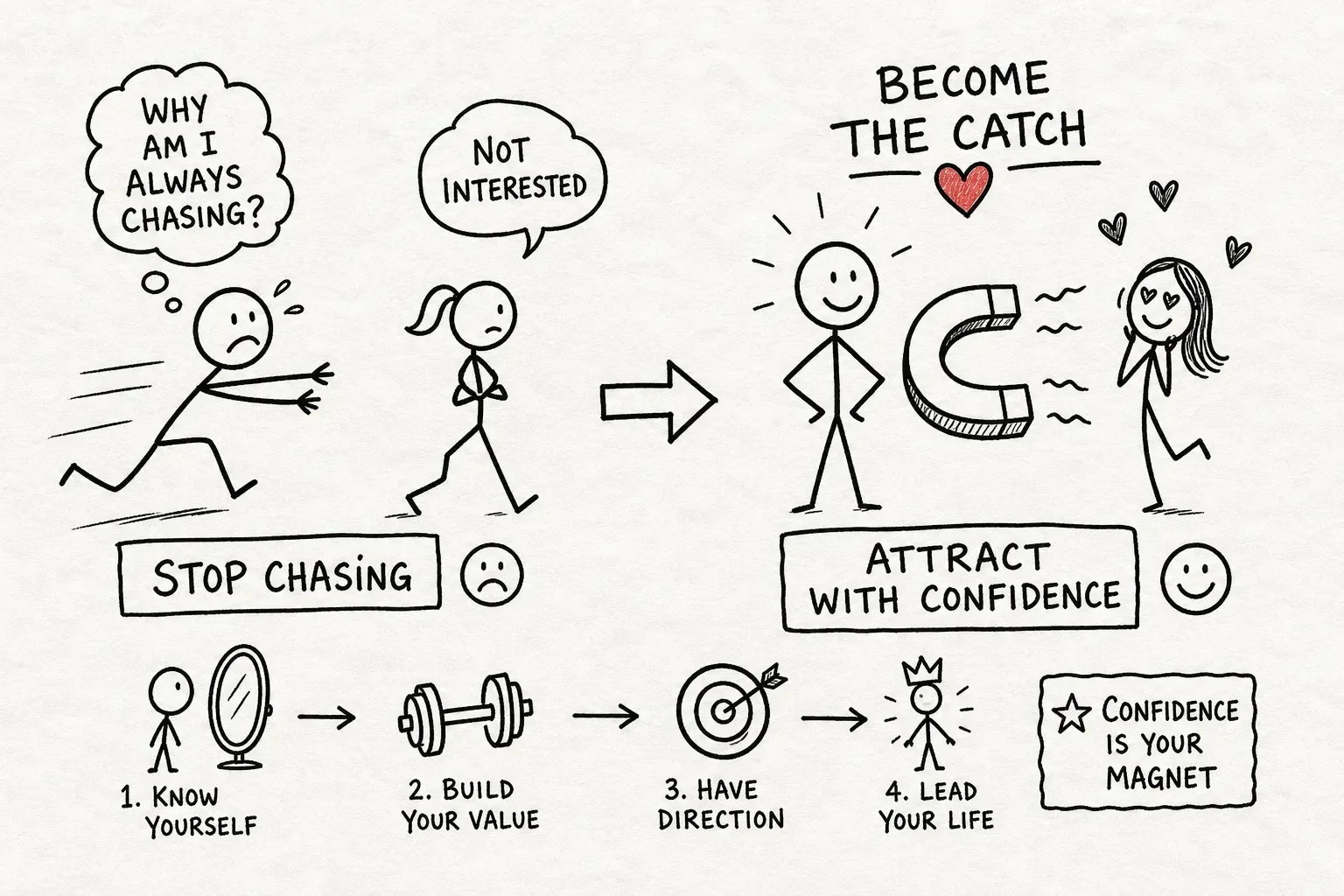
If you want to stop chasing women, the first thing to understand is that most men who fall into this pattern aren't desperate. Many are simply operating from a framework nobody ever corrected: if you want something, you go after it. The pursuit feels logical. But applied to people, that framework consistently produces the opposite result.
This pattern is more common than men admit. The wiring runs deep, and fixing it takes more than deciding to act differently. That's why resources like The Attraction Vault exist: not to teach scripts or tactics, but to address the actual behavioural roots of why the chasing cycle starts in the first place.
This article isn't about playing games or acting cold. It's about understanding why chasing backfires, and what to do instead — nine concrete strategies, a simple 30-day reset plan, and a few honest tools for setting boundaries without drama.
Why men chase women in the first place
Anxious attachment and the fear of abandonment
Chronic chasing usually isn't about the specific woman. It's about an internal state. Men with anxious attachment styles fear abandonment and seek reassurance through pursuit. When that's the driver, it doesn't matter how genuinely interested you are — any hint of distance triggers a protest response from your nervous system, and pursuit intensifies automatically.
Anxious attachment consistently pushes men to prioritise closeness over compatibility, often at the expense of genuine fit. That means the alarm goes off the moment she doesn't text back quickly, even when there's no real evidence of rejection. The system is trying to restore a sense of security, not assess the actual situation.
The validation loop: when the chase is about ego, not connection
For many men, the chase is less about genuine interest and more about what being wanted signals. Being chosen feels like confirmation of worth, desirability, and masculinity. That's not a character flaw — it's a very human pattern. But it means the pursuit is serving the ego, not the relationship.
Intermittent reinforcement makes this worse. When someone's attention is unpredictable, the brain treats it like a variable reward — more compelling, not less. Here's the honest test: if you'd lose interest the moment she became fully available and enthusiastic, the chase was never really about her.
Why chasing women often backfires
The scarcity trap: what persistent pursuit actually signals
When a man over-pursues, he communicates low self-worth without saying a word. He signals that her attention is scarce to him, which paradoxically makes it feel less valuable. Think of it like an empty restaurant. You walk past and wonder why nobody else is eating there. The same psychological signal fires when someone is always available, always reaching out, always trying harder than the other person.
Persistent pursuit after rejection consistently correlates with relationship dissatisfaction, not reconciliation or romantic success. The behaviour that feels like effort reads, from the outside, as instability.
How the cycle sustains itself
The pursuer-distancer pattern is self-reinforcing. The more one person chases, the more the other creates distance. That distance confirms the chaser's fear of abandonment, which intensifies the pursuit, which creates more distance. The cycle doesn't resolve; it deepens.
This is why the solution isn't learning to pursue more strategically. It's breaking the pattern entirely. The energy spent chasing needs to go somewhere else — specifically, inward.
How to stop chasing women: nine strategies to redirect your energy
Mindset shifts that change the dynamic (strategies 1–4)
Strategy 1: Reframe what attraction actually is. Attraction isn't built through persistence. It's built through presence, groundedness, and genuine self-possession. Replace the question "how do I get her?" with "do I actually want her?" That shift alone changes how you show up.
Strategy 2: Adopt a mutual-effort standard. Match her level of investment, not more. If she's not reciprocating, that's information, not a challenge to overcome with more effort. Ask yourself whether you'd still be this interested if she were equally enthusiastic from the start. The answer tells you a great deal.
Strategy 3: Challenge the scarcity belief. Ask yourself, honestly: "What is the evidence that I need her validation to feel okay?" Work through it properly. The belief is usually old, not accurate, and most men find the evidence thinner than expected once they actually examine it.
Strategy 4: Separate your worth from romantic outcomes. Your value doesn't change based on whether she texts back. That's not just a motivational statement; it's a fact you need to genuinely internalise, not just repeat to yourself. Stop chasing women by starting here: building an internal sense of worth that doesn't rise and fall with someone else's attention.
Behavioural strategies to break the chasing pattern (strategies 5–7)
Strategy 5: Use a 24-hour delay rule. When the urge to send a follow-up message hits, wait a minimum of 24 hours. This isn't game-playing. It's interrupting the automatic impulse-action loop that bypasses your actual judgement. The urge to reach out and the decision to reach out are two different things — this rule keeps them separate.
Strategy 6: Keep a trigger log for one week. Note the situation, the feeling, the thought, and what you did. Many men find their own patterns surprisingly predictable once they're written down, and that visibility is what makes change possible. The log doesn't fix anything by itself, but it shows you exactly where the work needs to go.
Strategy 7: Use one clear boundary script, then stop. Say what you mean once. Scripts that work without drama:
- "I'm looking for consistent communication, so I'm going to step back here."
- "I've noticed the effort isn't mutual here, so I'm going to step back."
- "If you'd like to talk, please reach out. I won't be following up."
Send it once. Don't follow up. A boundary only works if you actually hold it.
Daily habits that build genuine confidence over time (strategies 8–9)
Strategy 8: Build a life with non-negotiable anchors. Exercise, hobbies, friendships, and goals that have nothing to do with dating. When your nervous system has multiple genuine sources of regulation and satisfaction, no single person holds all the power over how you feel. This isn't advice to become detached — it's advice to become grounded.
Strategy 9: Keep one small daily promise to yourself. Not to her. Not to your mates. To yourself. Do what you said you'd do, even when it's minor. This is the quiet foundation of self-trust, and self-trust is what genuine confidence actually looks like from the inside.
Building self-worth that makes chasing unnecessary
Why inward investment is the real foundation of attraction
The men who stop chasing don't become cold or indifferent — they become grounded. People are drawn to partners who appear emotionally mature, self-directed, and not dependent on external validation to feel okay. That's not aloofness. It's self-respect. And it's something you build through consistent behaviour, not through tactics.
Redirecting energy inward means honouring your own goals, building skills you care about, and cultivating an identity that doesn't collapse without romantic confirmation. This isn't self-improvement as performance — it's self-investment as a way of living that happens, as a byproduct, to make you more attractive.
Boundary scripts that work without drama
Pick one of the phrases from Strategy 7. Say it clearly and calmly. Then redirect your attention, genuinely, to something in your own life. That redirection is the actual boundary, not the words. The script is just the signal. Meaning it is what changes the dynamic.
A simple 30-day reset to stop pursuing women and break the pattern
Weeks 1–2: building self-trust from scratch
The first fortnight is about internal work. Each morning, name three personal strengths and set one daily intention that has nothing to do with dating. Aim for 3–4 exercise sessions a week. Keep one small promise to yourself each day, even if it's minor. Have one brief social interaction — a cashier, a colleague, a neighbour — without any agenda.
The goal in weeks one and two is simple: prove to yourself that you can act without external validation driving every decision. That proof accumulates faster than most men expect.
Weeks 3–4: emotional independence in practice
In the final two weeks, introduce dating-specific elements. Prepare three genuine curiosity questions before any social interaction — not scripts, just real things you'd actually want to know. Schedule at least one low-stakes outing without attachment to outcome. Each evening, spend five minutes journalling: what felt authentic, what felt like chasing, and one thing you did for yourself that had nothing to do with getting someone's approval.
At the end of the month, revisit your trigger log from week one. The pattern becomes clear quickly when you track it honestly. Many men find the triggers are fewer than they thought, and the responses more habitual than inevitable.
When the pattern runs deeper than willpower
Recognising when anxious attachment is driving the bus
Habit-based strategies have real limits. For some men, the chasing pattern is tightly wound into their attachment history — inconsistent caregiving in childhood, a string of emotionally unavailable partners, or a breakup that rewired how they pursue connection. Willpower doesn't overwrite that kind of wiring.
Signs it runs deeper than habit: you've genuinely tried to stop pursuing women before and reverted within days; your anxiety becomes unmanageable when someone doesn't respond; or the same pattern shows up in friendships and workplace dynamics, not just dating. Those signals matter.
Structured resources worth exploring
This is where The Attraction Vault is built to help. The guides there are designed for men who've already figured out that the problem isn't tactics — it's foundational behavioural wiring. The flagship resource, The Attraction Blueprint, works through a six-step framework for building the kind of grounded presence that genuine attraction responds to. It's a practical starting point that sits well alongside other self-development work, and it's priced accessibly for men who aren't yet ready to commit to formal coaching.
That said, if the pattern consistently disrupts your relationships, working with a psychologist or relationship counsellor is a genuinely worthwhile investment. The Attraction Vault and professional support aren't either-or options — they work well together.
The real shift: stop chasing women and start building
Stopping the pursuit isn't about becoming someone who doesn't care. It's about becoming someone who cares about the right things, starting with himself. Genuine attraction is a byproduct of self-respect, presence, and mutual interest. You can't manufacture it through persistence, and more effort in the wrong direction doesn't change that.
The evidence on anxious attachment, intermittent reinforcement, and the pursuer-distancer dynamic all points in the same direction: the energy spent chasing is better spent building. Not as a strategy to seem more attractive, but because a grounded, self-directed life is worth having regardless of what any particular woman decides.
Pick one strategy from this article and apply it today. Not all nine. One shift, done consistently, changes more than nine strategies done halfheartedly. Stop chasing women by beginning with that.
FAQ
Q: Why do I keep chasing women even when I don't feel desperate?
A: Chasing often comes from an internal state like anxious attachment or a validation loop, not literal desperation. Men with anxious attachment fear abandonment and seek reassurance through pursuit, and for others the chase is driven by ego needs — being wanted confirms worth rather than genuine interest in the person.
Q: How does chasing women usually backfire?
A: Persistent pursuit signals low self-worth and scarcity, which makes your attention seem less valuable to the other person. That behaviour also feeds a pursuer–distancer cycle: more chasing creates more distance, which confirms your fear and intensifies the chase instead of resolving it.
Q: What is anxious attachment and how does it make me chase?
A: Anxious attachment is a pattern where fear of abandonment triggers a protest response whenever there's perceived distance, so pursuit becomes automatic. It leads men to prioritise closeness over compatibility and to misread short delays or ambiguity as rejection, driving repeated attempts to restore security.
Q: What's the simplest mindset shift to stop chasing women?
A: Reframe attraction as something built on presence, groundedness, and self-possession rather than persistence. Replace the question "How do I get her?" with "Do I actually want her?" — that change alters how you show up and reduces ego-driven pursuit.
Q: What does a mutual-effort standard look like in practice?
A: A mutual-effort standard means matching the other person's level of interest and investment instead of always overreaching. It encourages balanced exchange, reduces instability signalled by one-sided pursuit, and helps you assess compatibility rather than chasing validation.
Q: If I stop chasing, where should I put that energy instead?
A: Redirect that energy inward — toward presence, grounding, and building self-possession. Focusing on your values, boundaries, and activities that reinforce self-worth breaks the chasing cycle and creates healthier attraction dynamics.
Q: Are there tools or programs recommended to break the chasing pattern?
A: Yes — The Attraction Vault focuses on addressing behavioural roots rather than scripts or tactics. It also outlines a simple 30-day reset plan and practical boundary-setting tools to help rewire the pursuer–distancer cycle without drama.
-
Posted in
anxious attachment, attraction, confidence, dating advice for men, self-worth