
Why Fear of Rejection Overwhelms Men and How to Rewire It
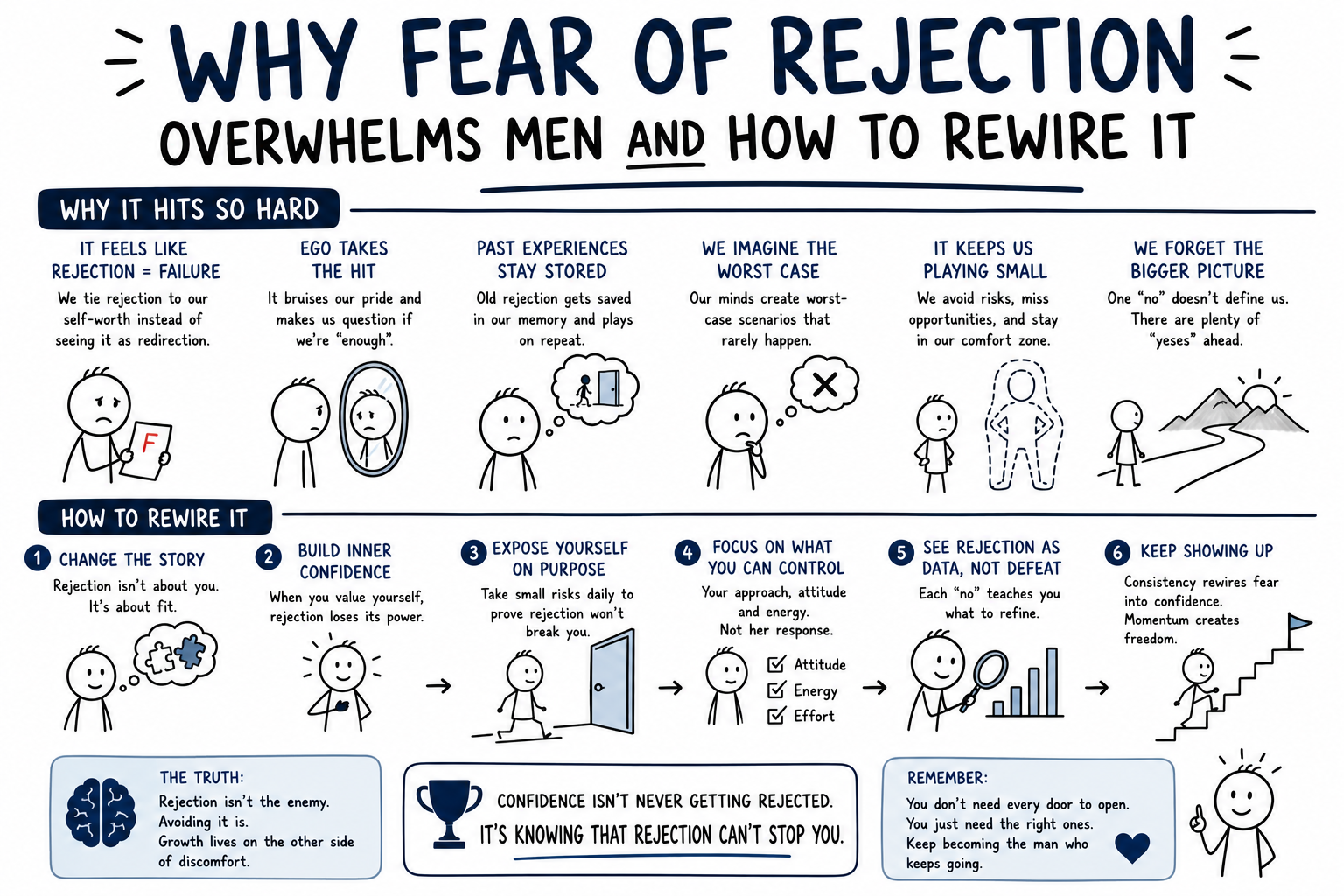
Many men don't avoid rejection because they're weak. The fear of rejection triggers a biological freeze response, and that response isn't a character flaw. It's biology running an outdated programme that evolved long before dating apps or job interviews existed.
The sting of social rejection is real, and there's solid neuroscience behind why it hurts as much as it does. This article isn't here to convince you rejection doesn't sting. What it will do is show you exactly why the fear of rejection hijacks your thinking and what you can actually do to rewire it.
What separates men who push through the freeze from those who stay stuck is rarely confidence as a personality trait. Evidence and clinical experience suggest that having a repeatable process is what shifts the equation — something that removes the decision-making burden before pressure arrives.
Why Fear of Rejection Hijacks Your Brain
The brain regions associated with physical pain — specifically the dorsal anterior cingulate cortex and the anterior insula — also activate during social rejection, according to foundational neuroimaging research on social pain. That's not metaphor. It's partially shared threat circuitry, which explains why being knocked back by someone you're attracted to can register in your nervous system like something that physically hurts.
The Ancestral Logic Behind the Freeze Response
In ancestral environments, being cut off from a group wasn't merely uncomfortable — it meant reduced access to food, protection, and mates. The brain evolved a hair-trigger alarm for social exclusion because the cost of missing a genuine rejection signal could be fatal. That alarm is still running today, even when the perceived threat is asking a woman for her number at a pub in Melbourne.
What the Social Pain Research Actually Means for You
The research is more nuanced than the headline version suggests. Rejection shares circuitry with physical pain, but they aren't identical. The practical implication: the distress is real and biologically grounded, but it is also malleable. The brain that learned to fear rejection can learn to respond to it differently. That is the entire premise of what follows.
The Signs That Fear of Rejection Is Quietly Running Your Decisions
Many men don't walk around thinking "I have a fear of rejection." They just find themselves not approaching, not applying, not speaking up. The avoidance is invisible because it's dressed up in reasonable-sounding explanations.
Avoidance Dressed Up as Being Strategic
The behavioural signs are often subtle. You don't approach women you're attracted to because the timing doesn't feel right. You don't ask for what you want at work because you don't want to seem pushy. You leave social situations early or default to texting instead of calling because real-time uncertainty feels unmanageable. These aren't preferences — they are avoidance patterns wearing the costume of pragmatism, and they tend to compound quietly over time.
Hypervigilance, Approval Seeking, and the Overthinking Loop
You read too much into a slow text reply. You replay a conversation looking for where you went wrong. You interpret neutral feedback as negative. After a perceived rejection, there's a disproportionate crash: sudden shame, irritability, or a loss of energy that lingers far longer than the situation warrants. This kind of approval seeking and hypervigilance is a hallmark of elevated rejection sensitivity — worth recognising as a pattern rather than a personality quirk.
Why Men Specifically Get Stuck in the Freeze
The biology of rejection fear is universal. But the cultural layer sitting on top of it for men amplifies the freeze rather than helping manage it. Research on male socialisation across Western cultures consistently points to emotional suppression as a central feature, and Australian men are no exception. Most generic content on this topic skips this part entirely.
The "Toughen Up" Conditioning That Makes It Worse
Male socialisation teaches men to suppress vulnerability rather than process it. The result is that many men never develop rejection resilience through deliberate practice. Instead, they learn avoidance and quietly label it stoicism. The pain has no outlet and no context, so it compounds over years without ever being examined or addressed directly.
Rejection Sensitivity vs Social Anxiety: Knowing Which You're Dealing With
These two things are related but not the same. Social anxiety is a broad-based fear of social situations, whereas rejection sensitivity — sometimes reaching the level clinicians describe as rejection sensitivity dysphoria (RSD) — is a more specific and often intense emotional reaction to perceived disapproval or exclusion. The distinction matters because the tools you reach for first should match the actual problem. Broad social fear responds well to graduated social exposure. Rejection sensitivity often requires direct work on the automatic interpretation of "no" as evidence of unworthiness.
Cognitive Reframing: Changing What Rejection Actually Means to You
CBT-based cognitive reframing has the strongest evidence base for social anxiety and fear of rejection, with medium to large effect sizes reported across multiple meta-analyses. The technique is simpler in practice than it sounds in the clinical literature, and you don't need a therapist's office to apply the core process — though self-help approaches are best suited to moderate avoidance patterns rather than severe impairment.
Tracking and Challenging the Automatic Thought
Write the situation. Write the automatic thought. Write the emotion it produces. Then interrogate the thought with specific questions: what evidence supports it, what contradicts it, and what's a more accurate interpretation? The goal is to take a thought like "she said no because I'm not enough" and turn it into something specific and testable, rather than a sweeping verdict on your worth as a man. That shift from global to specific is where reframing actually does its work.
Redefining What "No" Actually Means
The central cognitive distortion driving fear of rejection is the equation of a "no" with proof of unworthiness. The practical reframe: a "no" reflects timing, fit, circumstance, or personal preference — not a definitive assessment of your value. Practise separating the outcome from the identity. This shift eventually changes how your nervous system responds to uncertainty, and it comes through repetition rather than a single insight.
Graded Exposure to Reduce Fear of Rejection
Reframing changes the story you tell yourself. Exposure changes what your body has learned to expect. Avoidance maintains fear because your brain never receives evidence that the feared outcome is survivable. Graded exposure breaks that loop incrementally, using accumulated real-world evidence rather than affirmation or positive thinking.
Building an Exposure Ladder That Actually Works
List 6 to 10 situations ranked from lowest to highest feared. Start with genuinely low-stakes asks: requesting a small discount at a café, asking a stranger for directions, making eye contact and nodding at someone on the train. The goal isn't to engineer rejection on purpose — it's to accumulate evidence that uncertainty is tolerable and that most outcomes, when they arrive, are survivable, neutral, or even positive. That evidence is what retrains the threat response over time.
The Post-Rejection Debrief Habit
After any exposure, spend five minutes on a brief structured reflection. What did you predict would happen? What actually happened? What did you feel before and after? Over time, the consistent gap between catastrophic prediction and actual reality becomes its own reframe. Add a self-compassion reset at the end — calm, validating self-talk rather than self-criticism. That keeps the practice going when exposures feel uncomfortable, which they often will at first.
Why a Structured Process Beats Willpower When the Freeze Kicks In
Willpower runs out under pressure. A structured, repeatable process doesn't require you to feel ready — it requires you to follow a sequence, and that's a fundamentally different ask of your nervous system.
Having a Framework Removes the Decision Paralysis
A major reason the freeze wins is that men are making too many decisions in real-time under stress: what to say, how to say it, whether to approach at all, what the outcome might say about them. That cognitive load is enormous, and under threat-state conditions the brain can't handle it cleanly. A structured framework removes those in-the-moment decisions and replaces them with a sequence to follow — which keeps the prefrontal cortex engaged rather than handing control back to the threat-detection system.
This is the model behind The Attraction Vault's Approach Blueprint. The 6-step framework replaces decision paralysis with a clear, repeatable sequence built specifically for the conditions where fear of rejection typically causes men to freeze. It's not scripted lines or pickup tactics — it's a structure that shifts the decisions upstream, before the pressure arrives.
When to Consider Professional Support
Self-help tools are genuinely effective for moderate patterns of rejection avoidance. They are not a substitute for clinical care when the fear is debilitating. If avoidance is severely limiting your relationships, career, or daily functioning, a psychologist trained in CBT or ACT is the appropriate next step. In Australia, your GP can refer you to a psychologist under a Mental Health Treatment Plan for Medicare-subsidised sessions. Knowing when a problem requires professional support isn't a sign of weakness — it's sound judgement.
Frequently Asked Questions
Why does rejection hurt so much when dating?
fMRI studies show social rejection activates many of the same neural pathways as physical pain, because our brains run an ancient programme that once treated exclusion as a survival threat. That wiring makes a missed message or a swipe feel intensely personal even though it isn't a literal danger. Understanding this helps normalise the feeling rather than magnify it.
How common is fear of rejection among Australian singles?
A 2023 survey found 24% of Australian singles had stopped dating because they were tired of rejection and things not working out, while another 21% said the emotional cost of possible rejection was a direct barrier. That means roughly one in four singles experience this pattern, and it tends to compound over time as people date less and rejection feels bigger. It's not a fringe problem — it's a widespread dynamic.
What does it mean to treat rejection as a data point rather than a verdict?
Treating rejection as a data point means seeing a "no" as information about compatibility, timing, or context for that specific interaction — not as a statement of your worth. Many dating decisions on apps or in person are split-second compatibility filters, not deep character judgments. When you view each outcome as useful feedback, individual rejections carry far less emotional weight.
How can Australian men change their reaction to rejection in dating?
The evidence points to repeated, deliberate experience and practical mindset work — rather than suppressing feelings with a "she'll be right" script. Working through rejection, expecting a normal rate of non-responses, and reframing outcomes as information helps rebuild confidence. The Attraction Vault's resources are built around this practical approach to mindset change.
Do dating apps like Hinge and Bumble make rejection feel worse?
Yes, because those apps encourage very quick decisions based on a photo and a few lines, which activates the same ancient rejection response even though the stakes are low. The brain hasn't updated to treat a Hinge or Bumble notification as trivial, so non-responses can sting disproportionately. Knowing low match rates and rapid filtering are normal reduces the personal meaning of each outcome.
How does Australian culture affect how men handle rejection in dating?
Cultural norms like the tall poppy dynamic, the "don't try too hard" expectation, and embarrassment about showing vulnerability push many men toward suppressing rejection rather than processing it. That suppression is often rationalised as preference and leads to avoidance — men ask fewer people out and the fear compounds. Suppression is not the same as resilience.
What practical mindset shifts reduce the sting of rejection?
Key shifts are reframing rejection as informative rather than definitive, running the numbers honestly so each result carries less weight, and accepting that most interactions won't spark something meaningful. The goal becomes collecting information and improving odds over time rather than avoiding rejection altogether. Consistent dating and deliberate practice are the ways to change the pattern.
The Freeze Is a Habit, Not a Life Sentence
The fear of rejection is not a personality defect. It is an evolved system running in an environment it was never designed for. The science confirms the pain is real. The same science confirms it is changeable — and that distinction matters enormously.
The path is demanding but clear. Understand the biology so you stop pathologising the freeze. Recognise the behavioural patterns so you can see them for what they are. Apply cognitive reframing to challenge the distorted meaning you've attached to rejection. Use graded exposure to rebuild rejection resilience through evidence rather than affirmation. And if you want a repeatable structure to pull it together, The Attraction Vault's Approach Blueprint offers exactly that kind of step-by-step framework, built for men who are done leaving outcomes to chance.
The freeze is a habit. Habits respond to consistent, deliberate practice — and that's entirely within your control.