
Overcoming Approach Anxiety: The Complete Men's Guide
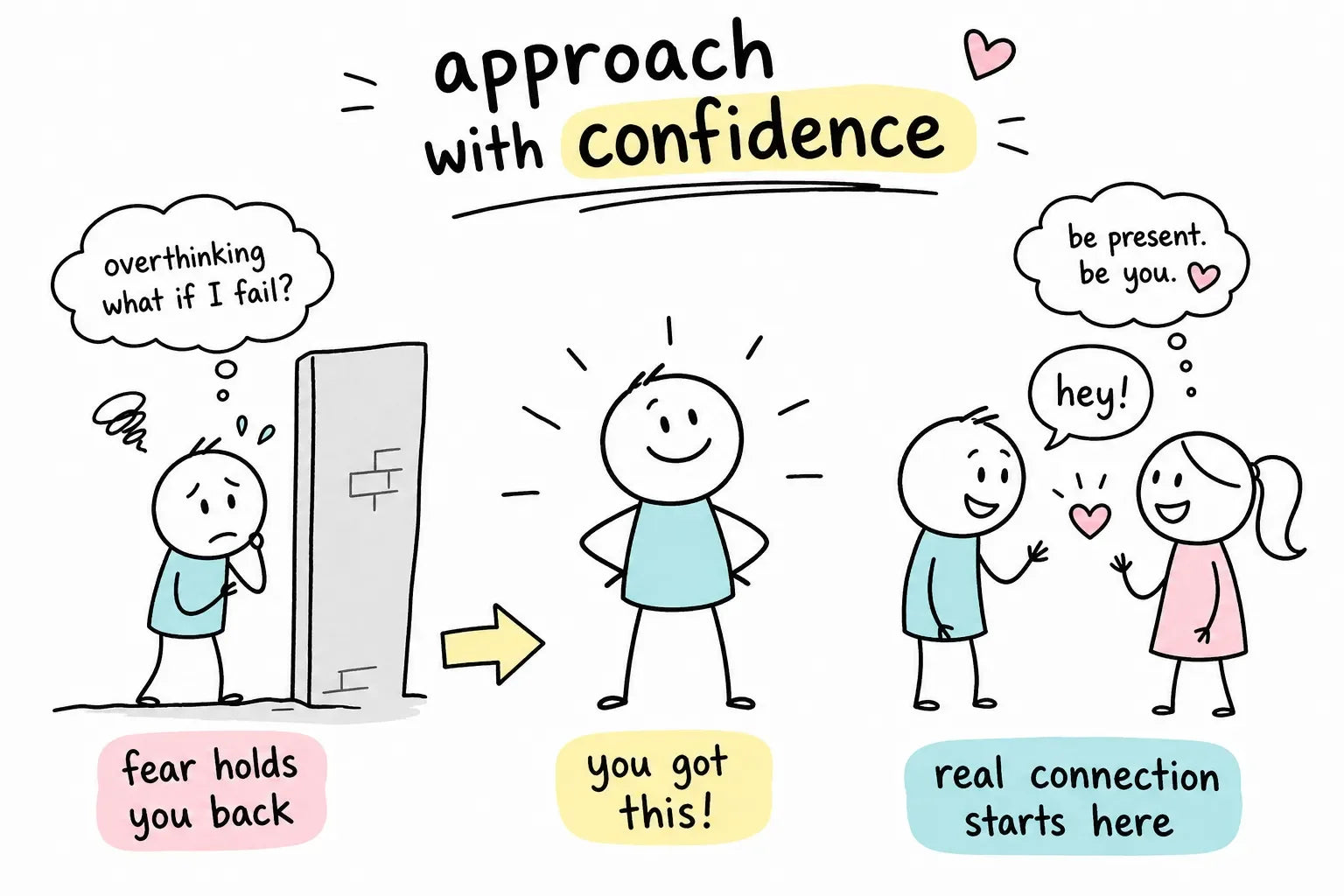
Overcoming approach anxiety starts with understanding what's actually happening in your body, and why willpower alone will never fix it. You know the moment. You spot someone across the room, your heart rate jumps, your mind goes blank, and you walk away having said nothing. It happens fast, and the shame that follows lingers far longer than the moment itself. What most men don't realise is that this isn't a character flaw or a sign that something is fundamentally wrong with them. It's a wired neurological response, and one the brain is remarkably good at reinforcing the longer it goes unchallenged.
Most men try to push through this on pure willpower. They psych themselves up, feel the spike of adrenaline, freeze anyway, and then decide the whole thing isn't worth it. Without a framework, that pattern repeats indefinitely. Structured, evidence-based practice is what actually moves the needle, not motivation alone. If you want a guided starting point beyond this article, The Attraction Vault's Approach Blueprint offers a six-step system for building the kind of quiet, grounded confidence that makes approaching feel natural rather than forced.
What Approach Anxiety Actually Is (And Why It's Not Weakness)
The Amygdala's Threat Alarm
When you move towards someone you find attractive or intimidating, your amygdala registers that moment as a potential social threat: rejection, humiliation, loss of status. It doesn't distinguish between a lion and a stranger at a bar. It fires an identical fight-or-flight signal, which means your heart rate spikes, your thinking clouds over, and a powerful impulse to avoid the situation kicks in. This is approach anxiety presenting physiologically, not a signal of low character or weak resolve.
The prefrontal cortex, which is responsible for rational decision-making, loses ground to the amygdala's faster signal. That's why knowing you "should just go talk to her" does nothing in the moment. The logical brain is already losing the argument before you've taken a single step.
The Difference Between Social Anxiety and Approach Anxiety
General social anxiety is broad. It affects performance in meetings, phone calls, group settings, and everyday interactions. Approach anxiety is specific: it centres on initiating contact with someone you find attractive or who holds some kind of social power over you. This distinction matters because the treatment path is more targeted and more achievable than many men assume. A narrower trigger responds well to focused, deliberate exposure practice rather than years of generalised therapy.
Why Approach Anxiety Can Be Especially Pronounced in Dating Situations
The Stakes Feel Biological, Not Just Social
In dating contexts, the perceived cost of rejection feels outsized. The brain links romantic pursuit to identity and status, which means a brief interaction with a stranger can feel like a referendum on your worth as a man. Many men are socialised to initiate, which places considerable weight on them from the start. One of the most consistent psychological patterns driving the freeze response is catastrophising the interaction before it begins — running a mental simulation of everything that could go wrong before a single word has been spoken.
How Avoidance Quietly Reinforces the Fear
Every time you walk away without approaching, your brain records that decision as the correct one. The relief you feel is real, but it's training your threat system to treat every future approach as equally dangerous. Avoidance is one of the key reasons confidence-building techniques fail when applied inconsistently. The fear doesn't shrink on its own over time. Without structured exposure, it tends to grow.
Overcoming Approach Anxiety: A 4-Week Exposure Ladder
How Graduated Exposure Actually Works
Graded exposure therapy asks you to face feared situations in a deliberate, step-by-step sequence rather than all at once. The clinical goal isn't to feel brave; it's to give your nervous system repeated evidence that the feared outcome rarely happens, and that even when rejection occurs, it's survivable. You build a hierarchy of situations ranked from least to most anxiety-provoking, then work up one rung at a time. Graded exposure is well-supported in the clinical literature on cognitive behavioural therapy across adult populations.
The Week-by-Week Breakdown
- Week 1: Eye contact, a genuine smile, and saying hello to strangers in low-stakes public settings: shops, lifts, walking paths, the gym.
- Week 2: Brief exchanges with a clear purpose. Ask for directions, comment on something in the environment, offer a short compliment with no expectation attached.
- Week 3: Longer conversations. Ask for a recommendation, make small talk at an event, introduce yourself to one new person per day.
- Week 4: Higher-stakes approaches. Initiate conversation with someone you're attracted to, sustain a short dialogue, and ask one follow-up question before the conversation ends.
The key is repetition at each rung before you advance. This builds real, durable approach confidence rather than the short-lived kind that runs on adrenaline and fades by the next week.
In-the-Moment Tips for Overcoming Approach Anxiety
The Breathing Protocol That Works Fastest
The physiological sigh is a rapid single-breath intervention for acute anxiety. Take two double inhales through the nose — a full breath followed by a top-up sniff — then a long, slow exhale through the mouth. Follow it with six to ten slow breaths where the exhale is longer than the inhale. This directly counteracts the fight-or-flight spike before a social approach situation escalates into a full freeze response.
Longer exhales activate the parasympathetic nervous system — the body's rest-and-digest response — which physically counters the sympathetic arousal driving the anxiety response. It's not a mindset trick. It's biology working in your favour.
Self-Talk Scripts That Reduce Threat Without False Hype
Elaborate positive affirmations don't work well before an approach because they ask your brain to believe something it doesn't yet accept. Short, specific phrases work better because they name the feeling, reduce the perceived threat, and direct attention to one concrete next action. Effective options include "one step, that's enough," "anxiety is not dangerous, it's just uncomfortable," and "feet, seat, breath" as a grounding cue.
Low-Pressure Opening Lines That Keep Anxiety Manageable
The Formula That Makes Initiating Easier
The highest-percentage openers are short, context-specific, and easy for the other person to respond to without feeling put on the spot. The practical formula: name yourself, use a simple situational bridge, and follow with one open-ended question. For example: "Hi, I'm [name]. Have you been here before?" There's no clever line to deliver and no specific answer to engineer. The goal is a natural next exchange, not a performance.
How to Talk to Strangers in the First 60 Seconds
Most men freeze not because they lack courage but because they have no script to fall back on when the brain goes offline. Knowing your three scripted moments in advance dramatically reduces that blank-mind problem. The opener gets you started. The first follow-up keeps the conversation alive: "What brings you here tonight?" or "How do you know the host?" The soft exit gives you a graceful out: "Good to meet you, I'll let you get back to it." These three moments cover most approaches entirely.
When Self-Help Isn't Enough: Getting Support in Australia
Signs the Anxiety Has Moved Beyond Approach Situations
When anxiety starts affecting sleep, work performance, appetite, or causes consistent avoidance of social situations beyond dating contexts, professional support becomes the appropriate next step. Persistent symptoms lasting two weeks or more, recurring panic attacks, or anxiety that is worsening despite consistent self-help practice are clear indicators that the exposure ladder alone won't be enough.
How to Access Help in Australia
The most direct path is a GP visit and a Mental Health Treatment Plan, which unlocks Medicare-subsidised sessions with a registered psychologist. Free national options include MindSpot on 1800 614 434 and Medicare Mental Health on 1800 595 212. For men under 25, Headspace centres offer accessible entry points without the need for a GP referral. Cognitive behavioural therapy with graded exposure is the evidence-based first-line treatment for approach-specific anxiety.
Frequently Asked Questions
What is approach anxiety and what's happening in my body when it occurs?
Approach anxiety is a wired neurological response that kicks in when you move toward someone you find attractive or intimidating. The amygdala treats the moment as a potential social threat, triggering a fight-or-flight reaction that spikes heart rate and clouds thinking while the prefrontal cortex loses ground. It's physiological rather than a character flaw.
How is approach anxiety different from general social anxiety?
General social anxiety is broad and affects many performance situations like meetings or phone calls, while approach anxiety is specific to initiating contact with someone you find attractive or socially powerful. Because the trigger is narrower, it tends to respond better to targeted exposure practice rather than generalised long-term therapy.
Why does approaching someone in dating feel more intense than other social situations?
In dating contexts the brain links romantic pursuit to identity and status, making the perceived cost of rejection feel outsized. Socialisation that places initiation pressure on men and mental catastrophising — running worst-case scenarios before speaking — further amplify the freeze response.
Can I just use willpower or motivation to overcome approach anxiety?
No — willpower alone rarely works because the amygdala's fast threat signal overwhelms rational intent in the moment. Structured, evidence-based practice and deliberate exposure are what actually change the brain's response over time, not motivation by itself.
How does avoidance make approach anxiety worse?
Every time you avoid approaching, your brain records the decision as correct and feels immediate relief, which reinforces the threat response. That cycle trains the nervous system to treat future approaches as dangerous, so the fear tends to grow without structured exposure.
What practical first steps can I take to start reducing approach anxiety?
Begin with focused, incremental exposure exercises that challenge the avoidance pattern in manageable steps and track progress consistently. If you want guided materials, The Attraction Vault's Approach Blueprint offers a six-step system designed to build quiet, grounded confidence for approaching.
Is approach anxiety a sign I'm weak or flawed?
No — approach anxiety is a normal, evolved response driven by the amygdala and not an indicator of poor character. Recognising it as a neurological pattern that can be retrained makes the problem more solvable and less shame-inducing.
Start With the Smallest Step
Approach anxiety is a neurological response, not a permanent personality trait. Overcoming approach anxiety follows a predictable path when the method is right: understand the trigger, work a graduated exposure plan, use in-the-moment reset techniques, and seek professional support if the fear extends well beyond dating situations. The neuroscience, the clinical evidence, and the practical coaching all point to the same conclusion — this is a learnable skill, not a fixed characteristic.
The gap between knowing what to do and actually doing it is where most men stay stuck, often for years. A structured resource shortens that gap. The Attraction Vault's Approach Blueprint is designed to give you a clear, step-by-step framework rather than a loose collection of tips. Start with the smallest step on the exposure ladder today: say hello to one stranger in a low-stakes setting. Build from there.